Instagram Transcript Generator: Stereo Audio Cancels in Mono
Keep a channel that contains the voice and save it as a separate mono file before retrying a stereo recording that disappears when mixed down. This tool averages its decoded channels, so opposite versions of the same signal can cancel before speech recognition. Select the new file, choose its spoken language and compare the result with the voice in that channel.
A quiet-audio warning can describe the signal produced by combining channels, even when a channel in the saved recording contains speech. For this Instagram transcript generator, the relevant question is whether the voice survives that combination. Changing the language cannot restore a signal that the audio-reading step has already rejected.
What changing the right channel did
On November 4, 2026, we tested a matched set of locally constructed WAV files in the live tool, using the same desktop in-app browser and selecting English. All used our original synthetic sentence: Please review these words before you share the transcript.
No Instagram post or private recording was used.
For the matching stereo control, both channels carried the same samples. For the opposite-channel control, the left channel stayed unchanged and every right-channel sample was multiplied by minus one. We also kept the original channel as a separate mono file. The speech content and playing time were not rewritten between these controls.
| Selected file | Channel relationship | Visible result |
|---|---|---|
| Matching stereo | Right equals left | Please review these words before you share the transcript. |
| Opposite-channel stereo | Right equals negative left | No audible audio was found. Choose a file with clear speech. |
| Single original channel | Mono, with no second channel to add | Please review these words before you share the transcript. |
The opposite-channel file did not display a new transcript. The single-channel retry did. This is a recorded recovery with an exactly inverted test pair; it does not show that ordinary stereo recordings fail, or establish the cause of an unrelated file's warning. Successful recognition of the control sentence is not an accuracy guarantee.
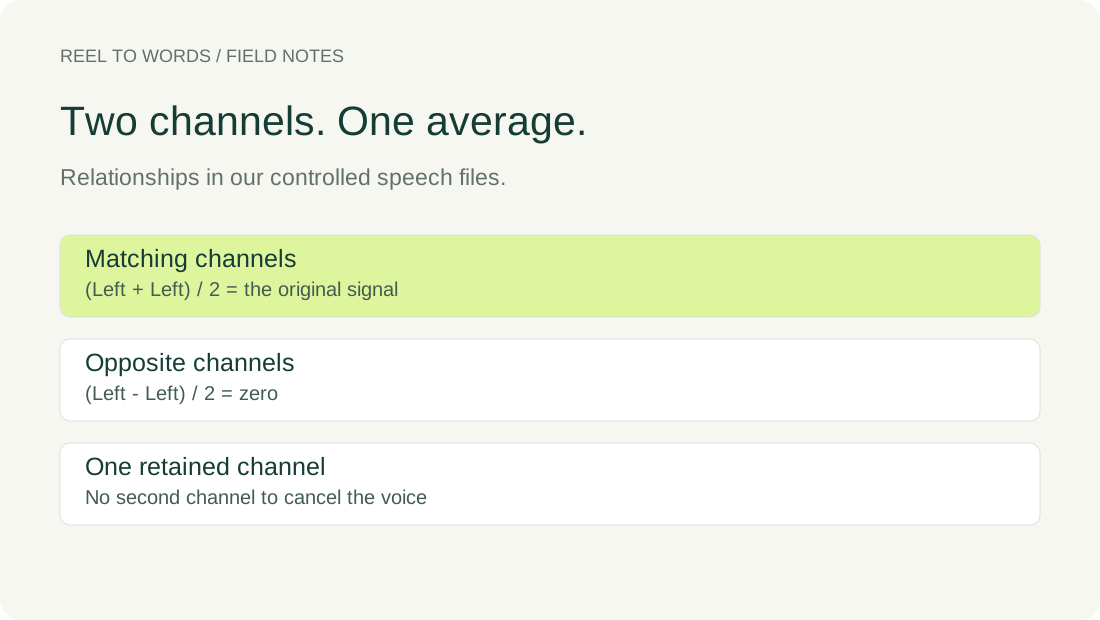
Why these channels produced different inputs
The published audio-reading code, in decode(), adds each decoded channel divided by the channel count. For a stereo input, that is mono[i] = left[i] / 2 + right[i] / 2. It checks the energy of that average before returning audio to the speech engine.
Our input manifest makes the arithmetic inspectable. At frame 2725, the original PCM value was 1075. The matching pair has (1075 + 1075) / 2 = 1075; the inverted pair has (1075 - 1075) / 2 = 0. These are measurements of the source PCM samples and their arithmetic, not a claim that we inspected the browser's internal decoded buffer.
The constructed inverted pair has this opposite relationship throughout the source file. The browser warning is consistent with cancellation in the averaging code. Keeping the original channel removes that cancelling addition, which is the preparation change tested here.
Repeat the channel check
The actual controls and recorded outcomes are available below. Select each file separately, choose English under Audio language, and use Generate transcript. Record the visible outcome before replacing the selected file. Do not mistake hidden text retained from an earlier run for a current result.
Matching stereo WAVOpposite-channel WAVSingle-channel WAVSample measurementsRecorded outcomes
Prepare the channel before selecting the file
The upload form has no channel picker. If your recording loses its voice when mixed down, inspect its separate channels in an editor and save the channel with the intended speech as a mono file. Simply choosing a mono export that averages the same opposite channels can preserve the problem; the preparation change is to retain the useful channel.
Choose that saved file in the upload box, set Audio language to the spoken language when known, then generate. Review the words against the retained channel. If the warning persists, this control test has not identified your file's cause; do not treat channel cancellation as the explanation for every failure.
Questions about the retry
Does every stereo file need conversion?
No. The matching stereo control produced the expected sentence. This investigation isolates a deliberately opposite channel pair, rather than identifying stereo itself as an unsupported format.
Can the language menu prevent this cancellation?
The code averages channels and checks audio energy before calling the speech engine with the selected language. Language selection does not change that averaging operation.
Is raising the volume the change tested here?
No. We retained a single original channel. Applying the same gain to exactly opposite channels leaves them opposite; their average still cancels. That arithmetic does not diagnose a quiet but otherwise different recording.
Keep the original stereo recording alongside the prepared channel file. When handing off the transcript, retain which channel supplied the words, so later review can return to that voice rather than to a different mix.